


It is a scenario that plays out at petrol stations across the country every single day. You are running late for work, your mind is on the day’s tasks, or you are wrangling kids in the back seat. You pull into the service station, grab the pump nozzle on autopilot, squeeze the trigger, and watch the numbers tick up. The actual Interesting Info about Fuel Drain Sydney.
Then, your stomach drops.
You look at the handle in your hand and realise you have just pumped unleaded petrol into your diesel car—or vice versa. This simple lapse in concentration is incredibly common, yet it is one of the most stressful experiences a driver can face. If you find yourself in this situation, you are not alone, and more importantly, the problem is entirely fixable if you take the right steps immediately.
Whether you are a local commuter or a tourist navigating the busy roads of New South Wales, understanding why these mistakes happen, what they do to your engine, and how a professional Fuel Drain Sydney service can save your vehicle is crucial.
In this comprehensive guide, we will explore the common mistakes leading to fuel drains, the mechanical science behind misfueling, the costs involved, and how to safely navigate the recovery process.
1. The Psychology of Misfueling: Why Do We Make This Mistake?
Misfueling is rarely a result of ignorance; it is almost always a product of circumstance, habit, or distraction. Understanding the root causes of misfueling can help you stay vigilant and avoid the ordeal altogether.
Driving a Borrowed or Rental Vehicle
One of the most common reasons drivers require a fuel drain service is unfamiliarity with the vehicle. If you normally drive an unleaded hatchback but rent a diesel SUV for a weekend getaway from Sydney to the Blue Mountains, muscle memory can easily take over at the pump. You reach for the unleaded nozzle because that is what you have done for the last ten years.
Multi-Car Households
Many households today operate a mix of vehicles—perhaps a diesel 4WD for family trips and towing, and a small petrol car for city commuting. Switching between these vehicles daily can cause cognitive mix-ups. It only takes a split second of inattention to treat the diesel workhorse like the petrol city runabout.
Pump Colour Confusion
While there are industry standards for fuel pump colours in Australia (often yellow for diesel, green for unleaded, and blue for premium unleaded), these are not strictly regulated or uniform across all independent service stations. If you are used to a specific service station brand and suddenly visit a different one with older or differently branded pumps, visual confusion can easily lead to a wrong-fuel incident.
Distraction and “Autopilot”
We live in an age of constant distraction. Talking on the phone (even hands-free), mentally preparing for a meeting, or dealing with an argument in the back seat shifts our brain into “autopilot” mode. When performing a mundane task like refueling, autopilot relies on deeply ingrained habits, which might not match the specific car you are currently driving.
2. The Science of the Mix-Up: What Actually Happens in Your Engine?
To understand why misfueling is treated as a mechanical emergency, we need to look at how petrol and diesel engines differ. They operate on entirely different combustion principles, and the fuels they use have vastly different chemical properties.
Unleaded Petrol in a Diesel Engine: The Ultimate Hazard
The most frequent—and arguably the most dangerous—misfueling scenario is putting petrol into a diesel vehicle. If you are wondering what happens if I put petrol in a diesel car, the answer lies in the concept of “lubricity.”
Diesel fuel is a heavy, oil-based liquid. It acts not only as a combustible energy source but also as a crucial lubricant for the engine’s intricate, high-pressure fuel pump (HPFP) and fuel injectors. These components are manufactured with microscopic tolerances.
Petrol, on the other hand, is a much lighter, highly refined solvent. When unleaded petrol is introduced into a diesel system, it immediately strips away the lubricating oil layer left by diesel.
If the engine is started, the high-pressure fuel pump runs without lubrication. The metal-on-metal friction causes the pump to grind against itself, generating thousands of microscopic metal shards. These shards are then pushed through the fuel lines and forced into the delicate fuel injectors, effectively destroying the entire fuel injection system.
This is why unleaded petrol in diesel engine repair can be extraordinarily expensive if the car is driven. It often requires replacing the fuel pump, all injectors, fuel rails, and sometimes even the fuel tank itself. The key to preventing engine damage after misfueling is to never turn the key in the ignition.
Diesel in a Petrol Engine: Messy but Less Catastrophic
Putting diesel into a petrol car is much harder because diesel nozzles are typically thicker and do not fit easily into the narrow filler neck of a modern unleaded vehicle. However, it still happens, often via jerry cans or persistent force.
So, what are the symptoms of diesel in a petrol engine? Petrol engines rely on spark plugs to ignite a fine mist of highly combustible fuel. Diesel is thick and heavy and requires intense compression—not a spark—to ignite.
If you start a petrol car with diesel in the tank, the fuel system will struggle to push the thick liquid through the fuel filter and injectors. The spark plugs will become fouled and coated with diesel oil, preventing them from igniting.
Symptoms include:
- Engine sputtering and violent misfiring.
- Thick, white or grey smoke billowing from the exhaust.
- The engine completely stalling and refusing to restart.
- A strong, oily smell.
While putting diesel into a petrol engine will stop the car in its tracks, doing the reverse is generally less catastrophic. The diesel will clog the system and foul the spark plugs, but it does not usually cause the destructive metal-on-metal friction seen in diesel engines. A thorough fuel tank service to flush the lines and clean the plugs is usually enough to get the car running again.
3. The Modern Misfuel: AdBlue Contamination
Modern diesel vehicles equipped with Selective Catalytic Reduction (SCR) systems require AdBlue (Diesel Exhaust Fluid) to reduce harmful emissions. AdBlue has its own dedicated filler tank, usually located next to the diesel filler cap, which unfortunately leads to a very modern, very destructive type of misfueling.
Putting AdBlue in the Diesel Tank
AdBlue is not a fuel additive; it is a mixture of high-purity urea and deionised water. It is highly corrosive to certain metals and reacts disastrously when mixed with diesel fuel.
If you accidentally pour AdBlue into your diesel fuel tank, you are dealing with a severe emergency. Because AdBlue is heavier than diesel, it sinks directly to the bottom of the fuel tank—right where the fuel pickup line sits. If you turn the ignition on, the vehicle will immediately suck AdBlue into the fuel pump and injectors.
When exposed to the heat and pressure of the injection system, AdBlue crystallises. It will cause severe corrosion and rust, and completely seize the engine’s internal components.
AdBlue Contamination Removal Guide
If you realise you have poured AdBlue into the diesel tank:
- Do absolutely nothing. Do not open the car doors if you have a modern car with a proximity key, as this can sometimes prime the low-pressure fuel pump.
- Do not turn the ignition. Even setting the key to the “Accessories” position can activate the fuel lines.
- Call a specialist immediately. You need an emergency fuel tank flushing service.
The safe way to drain contaminated fuel when AdBlue is involved requires a complete evacuation of the tank, a thorough chemical flush, and sometimes the physical removal and deep cleaning of the fuel tank. Under no circumstances should you attempt to dilute the AdBlue or drive the vehicle.
4. Spotting the Danger: Symptoms to Watch For
Sometimes, drivers do not realise their mistake at the pump. They pay, get in the car, and drive off. It is only when the vehicle starts acting erratically that they realise something is wrong. Knowing the signs of contaminated fuel in fuel lines can save your engine from total destruction if you act fast enough.
If you have driven away after a misfuel, look out for these warning signs:
- Loss of Power: The engine will feel incredibly sluggish. Pressing the accelerator will yield little to no response.
- Knocking or Pinging Sounds: The engine will start to sound like a tractor or emit a metallic rattling noise. This is the sound of improper combustion and mechanical distress.
- Excessive Exhaust Smoke: Depending on the mix-up, you will see thick white, blue, or black smoke pouring from the tailpipe.
- Stalling: The car will likely jerk, shudder, and eventually stall completely.
- Engine Warning Lights: The dashboard will light up with check engine, coil, or DPF (Diesel Particulate Filter) warnings.
If you experience any of these symptoms shortly after leaving a service station, pull over safely immediately. Turn off the engine and do not attempt to restart it.
5. Immediate Actions to Take (and Avoid) After Misfueling
The moments immediately following the realisation that you have misfueled are critical. Your actions here dictate whether you will pay a few hundred dollars for a fuel drain sydney service or several thousand dollars for a complete engine rebuild.
The Golden Rule: DO NOT START THE ENGINE
We cannot stress this enough. The fuel system in most modern cars lies dormant until you engage the ignition. By keeping the key out of the ignition, the wrong fuel remains isolated in the fuel tank. It has not reached the fuel lines, filters, pumps, or injectors. At this stage, the fix is relatively simple and inexpensive.
Do Not Even Turn the Key to “Accessories”
In many modern vehicles, simply unlocking the car or turning the key one click to listen to the radio engages the low-pressure fuel pump in the tank. This pump primes the system, sending a rush of fuel from the tank into the lines. Even if the engine isn’t running, turning the key can push the contaminated fuel into the sensitive components.
What You Should Do:
- Stop Fueling: The moment you realise the mistake, release the pump trigger.
- Inform the Attendant: Go inside the service station and tell the staff. They deal with this constantly. They will help you put traffic cones around your car so you don’t block the pumps while you wait for help.
- Push the Car (If Safe): Put the car in neutral and ask for help to push it out of the way of the fuel pumps to a safe parking bay.
- Call for Professional Help: Search for a 24/7 mobile fuel rescue solutions provider or a dedicated fuel drain specialist in your area.
6. DIY Disasters: Why You Shouldn’t Fix It Yourself
In the age of YouTube tutorials, it is tempting to think you can siphon the fuel out yourself to save money. Attempting to drain contaminated fuel without professional equipment is not just ineffective; it is incredibly dangerous and often illegal.
The Dangers of Siphoning
Modern cars are equipped with anti-siphon valves in the filler neck to prevent fuel theft. You cannot simply push a garden hose down into the tank and suck the fuel out. Attempting to force a hose past these valves can cause permanent damage to the filler neck, resulting in a costly repair.
Fire and Explosion Risks
Fuel vapors are highly volatile. Without specialized, anti-static ATEX-approved pumping equipment, the static electricity generated by moving liquids through plastic tubing can create a spark. A single spark near an open fuel tank can cause a catastrophic explosion.
Environmental Regulations
What do you plan to do with 50 litres of highly toxic, mixed fuel? You cannot pour it down the drain, dump it in the dirt, or throw it in the household bin. In New South Wales, the illegal dumping of hazardous waste carries massive fines. Professional fuel drain services carry specialized storage tanks and have contracts with environmental agencies to recycle or dispose of contaminated fuel legally and safely.
The safe way to drain contaminated fuel is to leave it to fully insured professionals who possess the right equipment, safety training, and environmental permits.
7. Roadside Assistance for Wrong Fuel: Mobile vs. Towing
When you find yourself stranded at a Sydney servo with the wrong fuel in your tank, you generally have two options to resolve the situation: calling a mobile fuel drain specialist or having your car towed to a mechanic.
Understanding the difference between a mobile fuel doctor vs towing to mechanic is vital for saving time, money, and stress.
Option A: Towing to a Mechanic or Dealership
Historically, the only way to fix a misfuel was to call a tow truck.
The Process:
- You wait 1-2 hours for a tow truck to arrive.
- Your car is winched onto a flatbed (which can be difficult if it is stuck in a tight service station forecourt).
- The car is towed to a mechanic or dealership.
- If it is the weekend or after hours, your car sits in a holding yard until the workshop opens.
- The mechanic removes the fuel tank entirely to drain it, which incurs heavy labor costs.
The Drawbacks: You pay for the tow truck, you pay high dealership labor rates, and you are left without a car for days. Furthermore, dealerships are notoriously quick to suggest replacing the entire fuel system (often costing upwards of $8,000) rather than attempting a flush.
Option B: Mobile Fuel Evacuation Service NSW
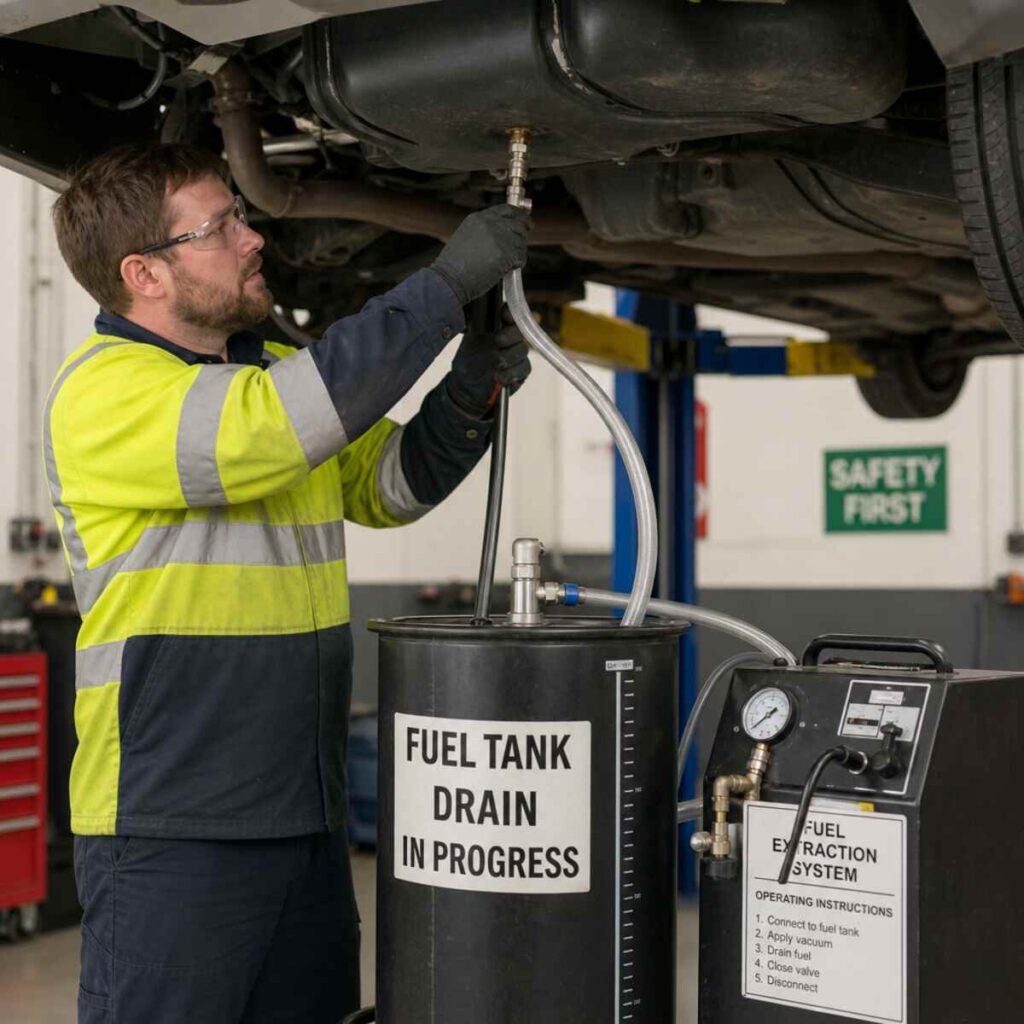
The modern, more efficient alternative is a dedicated mobile fuel drain service. These are specially equipped vans fitted with industrial, anti-static fuel extraction systems.
The Process:
- You call a mobile fuel evacuation service provider in NSW.
- They arrive at your location (often within 45-60 minutes), whether you are at a petrol station, on the side of the road, or in your driveway.
- They secure the area with cones and safety equipment.
- Using specialist diagnostic tools, they bypass the anti-siphon valve and connect directly to the fuel lines.
- They completely evacuate the contaminated fuel into their onboard hazardous waste tanks.
- They flush the lines with clean fuel, prime the system, and restart the engine for you.
The Benefits: You do not pay for a tow truck. The process usually takes less than an hour from the time the technician arrives. You can drive away immediately and continue your day. For almost every non-driven misfuel, a mobile roadside assistance for wrong fuel is the smartest choice.
8. The Fuel Drain Process Explained: What the Professionals Do
Have you ever wondered what exactly happens during an emergency fuel tank flushing service? It is more complex than simply draining a bathtub. Here is a step-by-step look at how a professional fuel drain sydney technician revives your vehicle.
Step 1: Site Safety and Assessment
Upon arrival, the technician will secure the area. Working with volatile fuels requires strict safety protocols, including grounding the vehicle to prevent static sparks and placing fire extinguishers nearby. The technician will then assess the vehicle to confirm the fuel type, engine type, and whether the ignition was turned on.
Step 2: Accessing the Fuel Tank
Depending on the car’s make and model, the technician will determine the best way to access the fuel tank. In many modern vehicles, accessing the tank through the filler neck is impossible due to the anti-siphon valve. Instead, the technician will lift the rear seats to access the fuel sender unit or connect directly to the fuel lines under the bonnet.
Step 3: Evacuation
Using an ATEX-approved pneumatic pumping system (driven by compressed air rather than electricity to eliminate the risk of sparks), the technician will pump out the fuel tank’s contents. This includes the wrong fuel, the right fuel, and any sediment sitting at the bottom of the tank.
Step 4: Line Flushing (If Necessary)
If the ignition was turned on or the car was driven, the contaminated fuel would have entered the fuel lines and the filter. The technician will perform a deep flush. They will disconnect the fuel lines leading to the engine and push clean, uncontaminated fuel through the system to purge any residual mixed fuel.
Step 5: Filter Replacement
If the car was started, the fuel filter will likely need to be replaced. The filter’s job is to catch impurities; if petrol has run through a diesel filter, it degrades the filter media. A professional technician will usually carry common filters in their van or advise you to replace them immediately.
Step 6: Priming and Restarting
Modern fuel systems operate under immense pressure and do not tolerate air bubbles in the lines. After the tank is filled with the correct fuel, the technician will use diagnostic software or manual priming pumps to bleed air from the fuel system. Finally, they will start the engine, check for leaks, monitor the exhaust for smoke, and ensure the car is idling smoothly before handing the keys back.
9. The Financial Aspect: How Much Does It Cost?
Money is usually the first thing on a driver’s mind after realizing they have misfueled. The cost of recovering from the wrong fuel in a car varies widely depending on your actions immediately after the mistake. Let’s break down the expected costs.
Scenario 1: You Did Not Start the Engine
If you realised your mistake at the pump and kept the keys out of the ignition, you are in the best possible scenario.
- Action: Mobile fuel drain service.
- Estimated Cost: The cost of professional fuel tank cleaning and draining by a mobile unit in Sydney typically ranges from $250 to $450, depending on your location, the time of day, and the tank size.
- Outcome: You lose the money you spent on the wrong fuel, pay the call-out fee, and drive away an hour later with zero engine damage.
Scenario 2: You Started the Engine or Drove a Short Distance
If you drove until the car shuddered and stalled, the situation is more serious but often still salvageable without full mechanical replacement.
- Action: Mobile fuel drain, line flush, and fuel filter replacement.
- Estimated Cost: $400 to $800. The extra cost covers the time required to flush the lines, bleed the system, and install a new fuel filter.
- Outcome: The car should recover, though there is a small risk that the high-pressure fuel pump has suffered minor, long-term wear.
Scenario 3: Catastrophic Failure (Dealership Repair)
If you drove the car at highway speeds until it completely died, and the high-pressure fuel pump shattered, sending metal shards through the injectors.
- Action: Towing to a workshop, complete replacement of the fuel system.
- Estimated Cost: $5,000 to $15,000+. This includes a new fuel tank, fuel lines, high-pressure pump, common rail, and all injectors, plus heavy labor costs.
- Outcome: A massive financial blow and being without your car for weeks.
Is Misfueling Covered by Insurance Australia?
A very common question is: Is misfueling covered by insurance in Australia?
The answer is: It depends, but usually no. Most standard comprehensive car insurance policies in Australia classify misfueling as “driver negligence” rather than an accident or act of nature. Therefore, they explicitly exclude damage caused by putting the wrong fuel in the car.
However, some premium insurance policies or specific roadside assistance packages do offer misfueling cover as an optional extra. This might cover the cost of the fuel drain service or the towing, but rarely covers a $10,000 engine rebuild. It is highly recommended that you read your specific Product Disclosure Statement (PDS) to understand your position.
Because insurance rarely covers the damage, paying a few hundred dollars for a 24/7 mobile fuel rescue service is the smartest financial decision you can make.
10. Choosing the Right Fuel Drain Service in Sydney
If you are stuck on the side of the M4 or at a servo in the Northern Beaches, a quick Google search will yield several results. How do you choose the right provider for your Fuel Drain Sydney emergency?
Here is what you should look for to ensure you are getting a reputable service:
1. 24/7 Availability
Misfueling doesn’t just happen during business hours. It happens at 5 AM on the way to a worksite or at midnight on the way back from a road trip. Look for a provider offering genuine 24/7 mobile fuel rescue solutions. Ensure you can speak with a technician, not just an answering service.
2. Industry Certifications and Insurance
The technician will handle highly flammable liquids and work on expensive, complex engine systems. Ensure the company is fully licensed, holds motor vehicle repairer licenses, and has comprehensive public liability insurance.
3. Transparent Pricing
A reputable fuel drain service will ask you a few questions over the phone (Make, model, did you start the engine, location) and give you a fixed, upfront quote. Beware of services that quote a very low call-out fee but hide massive per-litre disposal charges in the fine print.
4. Specialised Equipment
Ask if they use ATEX-approved pumping equipment. A standard mechanic throwing a jerry can and a plastic hose in the back of a ute is not a professional fuel drainer. Proper mobile units are essentially hazardous-materials vehicles designed specifically for emergency fuel-tank flushing service.
5. Proper Waste Disposal Practices
Compliance with the Environment Protection Authority (EPA) is non-negotiable. Reputable companies will happily explain how they recycle or dispose of the contaminated fuel at certified liquid waste facilities.
11. How to Prevent Future Misfueling Mistakes
Once you have experienced the panic of misfueling and paid for a fuel tank service, you will likely be paranoid at the pump for months to come. However, human error can always creep back in. Here are some proactive, actionable ways to permanently prevent misfueling.
Use a Misfuel Prevention Device
If you drive a diesel car, you can install a misfuel prevention cap. These are clever mechanical devices that replace your standard fuel cap. They feature a locking mechanism that opens only when a nozzle with the exact diameter of a diesel pump is inserted. Because unleaded nozzles are smaller, they cannot physically push the lock open, making it impossible to put petrol in the diesel tank.
Visual Reminders
Sometimes, the simplest solutions are the most effective.
- Stickers: Buy a bright yellow “DIESEL ONLY” sticker and place it directly on the inside of the fuel flap.
- Dash Reminders: If you frequently switch cars, put a sticky note on the dashboard or near the diesel vehicle’s fuel gauge.
Change Your Habits at the Pump
Force yourself into a new routine. When you pull up to the pump, don’t just grab the nozzle. Read the label on the pump handle out loud. Say to yourself, “I am putting Diesel in a Diesel car.” It feels silly, but vocalising the action breaks you out of autopilot and forces you to think consciously.
Be Extra Cautious with Jerry Cans
Jerry cans are notorious for causing fuel mix-ups. People use a red can (standard for unleaded) to buy diesel for a tractor, and months later, someone pours it into the lawnmower. Always use colour-coded jerry cans (Red for Unleaded, Yellow or Black for Diesel) and clearly label them with a permanent marker. If you are unsure what is in a jerry can, do not use it in your car.
12. Frequently Asked Questions About Fuel Drains
To round out our guide, let’s address some of the most common rapid-fire questions drivers have when facing a wrong-fuel scenario.
Can I just fill the rest of the tank with the right fuel to dilute it?
Absolutely not. This is an old wives’ tale from the days of simple, mechanical tractors in the 1980s. Modern common-rail diesel engines and direct-injection petrol engines operate under incredible pressures with microscopic tolerances. Even a 5% petrol mix in a diesel tank is enough to cause severe, lasting damage to the fuel pump. Do not attempt to dilute it; have a complete fuel drain service performed.
How long does a mobile fuel drain take?
If you did not start the engine, a professional technician can generally pump out the tank, flush the filler neck, and have you back on the road in 40 to 60 minutes after they arrive.
Will misfueling void my car's warranty?
Putting the wrong fuel in the car is considered user error, so any damage caused by the fuel will not be covered by the manufacturer’s warranty. However, having a professional, safe way to drain contaminated fuel done immediately (before damage occurs) will not inherently void the rest of your vehicle’s warranty. Dealerships prefer you not to break the car, and having it drained professionally prevents that.
Does premium unleaded hurt a diesel engine more than regular unleaded?
Chemically, premium unleaded (95 or 98 octane) has a higher concentration of cleaning additives and is even more refined than regular 91. This means it has even less lubricity. Therefore, it strips the lubrication from the diesel fuel pump even faster. Both are terrible for a diesel engine, but premium unleaded can arguably cause damage slightly quicker.
I put E10 in my premium-only petrol car. Do I need a fuel drain?
If your high-performance car requires 98 Octane and you accidentally put in E10 (94 Octane with 10% ethanol), you generally do not need an emergency fuel drain. The car will likely run rough, feel sluggish, and the check engine light might come on due to engine knocking. The best advice is to drive gently, avoid heavy acceleration, and top the tank up with 98 Octane as soon as there is room. However, if you put E10 in a boat or a classic car with a carburettor, you should have it drained, as ethanol degrades old rubber fuel lines.
13. Conclusion: Don’t Panic, Just Act Smart
Putting the wrong fuel in your car is a heart-sinking moment, but it does not have to be financially ruinous. The key takeaway from this comprehensive guide is simple: Do not start the engine.
By understanding your vehicle’s mechanics and recognising the psychological traps that lead to misfueling, you can better protect yourself at the pump. But if the worst does happen, knowing exactly who to call makes all the difference.
Bypassing the expensive tow trucks and dealership mechanics in favour of a dedicated Fuel Drain Sydney specialist is the quickest, safest, and most cost-effective way to save your engine. A mobile fuel drain service brings the workshop directly to you, using specialized equipment to safely extract the fuel and dispose of it legally.
Whether you are dealing with unleaded in a diesel, diesel in a petrol, or a disastrous AdBlue mix-up, remember that you are not the first person to make this mistake, and you certainly will not be the last. Stay calm, leave the keys on the passenger seat, call a 24/7 professional, and you will be back on the road before you know it.