

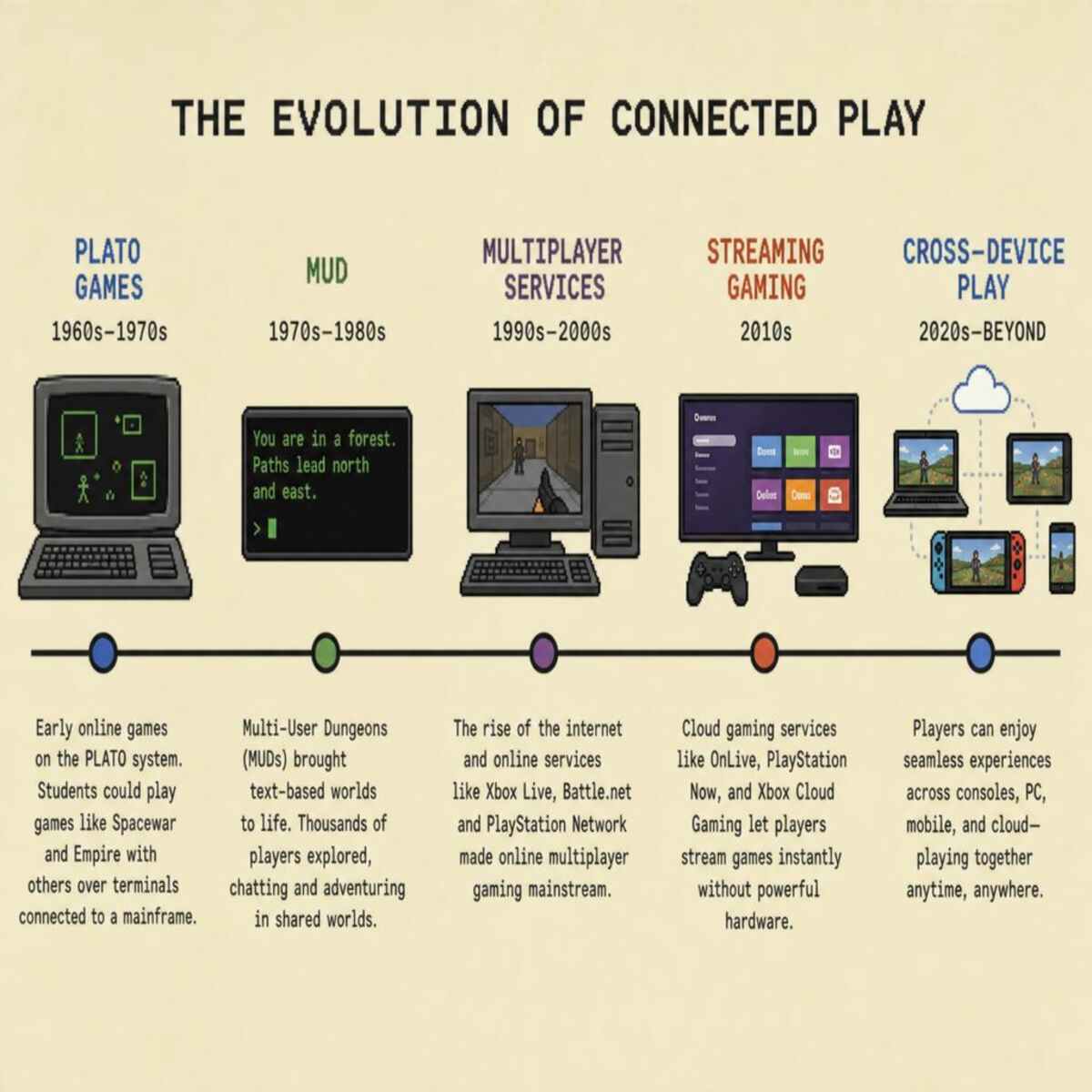
Online gaming communities have evolved from small groups sharing networked computers into interconnected spaces for play, conversation, spectatorship, and creative work. Understanding that evolution requires looking beyond better graphics or faster connections: the decisive changes concern how people meet, establish identities, organize activities, and negotiate responsibility. This article traces those developments and explains what players, moderators, and developers can learn. What do you consider about nagapetir.
How have online gaming communities evolved?
Online gaming communities have evolved through overlapping changes in access, communication, organization, and participation. Early networked environments showed that a game could also be a social space; later services added multiplayer discovery, persistent groups, cross-device play, broadcasting, and player-created content. These developments expanded what membership could mean, although they did not eliminate the smaller, relationship-based communities associated with earlier gaming.
A useful interpretation is that community became progressively less dependent on a single activity. Playing remains important, but a participant can also explain strategies, organize events, moderate discussions, create modifications, or watch broadcasts. Steam’s community features and Twitch’s creator resources illustrate this broader range of activities around games.
The distinction between an audience and a community is therefore essential. An audience shares an object of attention; a community also develops relationships, expectations, and some mechanism for coordinating behavior. For this article, that distinction provides a practical test: do participants merely encounter the same content, or do they recognize obligations and possibilities involving one another?
Consider four dimensions when examining any gaming group:
- Access: Identify what someone needs to participate, including equipment, payment, connectivity, language proficiency, and available time.
- Identity: Examine how members become recognizable and whether reputation carries across sessions, channels, or games.
- Coordination: Look at how activities are arranged, instructions are communicated, and shared knowledge is preserved.
- Governance: Establish who makes decisions, how rules are enforced, and what members can do when something goes wrong.
These dimensions prevent technological convenience from being mistaken for social progress. A platform might make joining almost effortless while leaving newcomers uncertain about expectations. Conversely, a technically modest group could offer clear instructions, dependable leadership, and rewarding participation.
The history is best understood as an accumulation of possibilities rather than a sequence in which each new platform renders its predecessors obsolete. The central question is not simply how many people a system connects. It is what those people can build together once connected.
Early networked games established the social foundations
Shared systems made interaction part of play
The University of Illinois’s account of PLATO describes an educational computing environment that also supported user-created communication programs and some of the earliest networked multiplayer games. Titles included Airfight and Empire, demonstrating that shared computer systems could support interaction extending beyond their original instructional purpose. The Computer History Museum similarly identifies PLATO games as early social, immersive digital environments.
The significance is not that these systems already resembled contemporary platforms. Rather, they established a foundational possibility: another person could be part of the environment, not merely someone sitting beside the machine. Communication and gameplay could occupy the same digital space. That combination created the conditions for relationships organized around repeated encounters.
From a community-design perspective, this suggests an important distinction between technical access and social continuity. Connecting two players permits an interaction; helping them recognize and find one another again permits a relationship. When evaluating later developments, it is useful to ask which of those problems a particular feature actually solves.
Text-based worlds made language central
MUD, developed at the University of Essex beginning in 1978, is another important reference point. Richard Bartle’s account explains that Roy Trubshaw’s earliest version consisted largely of interconnected locations in which people could move and chat. Bartle also describes external players reaching the system in 1980, extending participation beyond its immediate university setting.
In this setting, written communication was not an optional supplement to a visually complete world. Descriptions and commands were fundamental to navigating and understanding the environment. Bartle’s history also records difficulties when players added rooms and commands that undermined the setting’s coherence, revealing an early tension between participation and editorial control.
That tension remains useful to analyze. Allowing members to contribute can enlarge a world, but unrestricted contribution does not automatically produce a coherent experience. Someone must decide how additions relate to the existing environment, what quality means, and which changes should be reversible.
An analogous community exercise is to invite members to propose one new activity, then ask them to explain its audience, purpose, and relationship to existing activities. This turns contribution into a reasoned proposal rather than a contest for attention. It also makes the administrator’s eventual decision easier to explain.
Multiplayer services and persistent groups expanded organization
Integrated services reduced the distance between meeting and playing
Blizzard’s company history identifies Battle.net as a service incorporated directly into its games and launched alongside Diablo. Its account also describes StarCraft’s multiplayer competition through that platform. These examples mark an important organizational development: finding other players and entering a shared game could be treated as connected parts of the experience rather than entirely separate tasks.
The social implication is straightforward, although it should not be confused with an automatic guarantee of friendship. Reducing the effort required to locate a match makes contact easier; durable community still requires reasons to return to particular people. A convenient service can create opportunities, but participants must supply cooperation, recognition, and shared expectations.
Imagine two arrangements. In the first, players complete a session and have no obvious route to reconnect. In the second, they can identify a group, understand its schedule, and return to a recognizable conversation. The game itself might be identical, yet the second arrangement offers a clearer path from temporary cooperation to sustained membership.
This is a useful way to interpret platform features without becoming distracted by their names. A friend list addresses rediscovery; a recruitment tool addresses group formation; a discussion archive addresses continuity. Each solves a different social problem, and none should be assumed to solve the others.
Persistent groups required more explicit expectations
World of Warcraft provides a documented example of organized group discovery. Blizzard’s Guild & Communities Finder lets groups describe their interests and recruit participants, while its Classic community resources offer ways to reconnect with former friends and guildmates. Together, these features illustrate both prospective membership and the persistence of remembered relationships.
For a group planning repeated activities, compatibility deserves as much attention as enthusiasm. Members might agree that they enjoy a game while disagreeing about preparation, scheduling, competitive intensity, or acceptable mistakes. A recruitment message should therefore explain the experience being offered, not merely announce that more participants are wanted.
A useful group description should specify:
- Purpose: State whether the emphasis is learning, competition, exploration, creation, or relaxed conversation.
- Commitment: Explain expected attendance and how members should communicate absences.
- Preparation: Describe any knowledge or equipment requirements without disguising preferences as necessities.
- Conduct: Clarify how feedback, disagreement, and repeated disruption will be handled.
- Entry process: Tell newcomers whom to contact and what their first activity will involve.
These recommendations are not an argument for bureaucratizing friendship. They make implicit expectations visible before they become a source of resentment. A short, accurate description is more useful than an elaborate charter that nobody consults.
How did free games change community participation?
Free games changed the conditions of community entry by removing an upfront purchase requirement where their business model permits it. That makes trying a shared game a different decision from committing to a paid purchase, although equipment, connectivity, optional spending, and time can remain relevant considerations. Fortnite’s announcement that Battle Royale would become free on September 26, 2017, alongside the introduction of squads, provides a concrete example of free access being paired with group play.
The community implication is an inference rather than a universal outcome: when trying a game does not require buying it first, an invitation can be easier to accept. However, easier entry should not be mistaken for a complete onboarding strategy. A newcomer still needs to understand the controls, the group’s expectations, and what a successful first session looks like.
Financial access and social access are different problems
For someone discovering games online, the advertised price is only one part of the decision. A useful evaluation should also ask whether the game supports the intended group, whether its communication options are suitable, and whether participation remains enjoyable without purchases. These are questions to investigate for each title, not assumptions to make from a pricing label.
Community organizers should apply the same discipline. Before recommending a game night, explain what’s necessary and what’s optional. If participants need a particular mode, account arrangement, or additional purchase, establish that before the event rather than leaving members to discover it under social pressure.
A simple planning checklist can prevent avoidable confusion:
- Verify the shared activity. Confirm that everyone can access the mode or experience being proposed.
- Separate required and optional spending. Describe purchases plainly rather than treating them as evidence of commitment.
- Prepare a first-session route. Choose an activity that introduces the group’s style without demanding extensive prior knowledge.
- Provide a non-purchase contribution. Let members help through organization, explanation, or participation rather than spending.
- Review the experience afterward. Ask whether any unexpected barriers prevented people from joining comfortably.
Business models deserve explicit discussion
Epic’s original Battle Royale announcement distinguished free access from planned cosmetic or similar purchases and stated that it would not sell competitive advantages. This historical distinction matters because access pricing and the sale of additional items are separate design decisions. A game being free to begin does not, by itself, describe its entire commercial structure. (fortnite.com)
For communities, the appropriate response is transparency rather than blanket approval or condemnation. Explain what members need, avoid pressuring anyone to match another person’s spending, and keep purchasing status separate from ordinary belonging. If an event depends on paid content, label that limitation clearly and consider an alternative activity.
The broader lesson is that lower entry costs create an opportunity for inclusion, not proof that inclusion has been achieved. Welcoming instructions, realistic expectations, and respect for different budgets still require deliberate work.
Cross-device play changed the boundaries of a group
Minecraft’s Better Together update, released on September 20, 2017, connected supported Xbox One, mobile, VR, and Windows 10 versions through its Bedrock-based experience. Microsoft’s announcement also described community server partners and access to player-made Marketplace content. The update shows how technical compatibility can change which friends can share an activity.
The important social development is not simply that another device becomes available. It is that group formation can become less dependent on everyone owning the same hardware. This is an inference from the cross-device arrangement, not a claim that every edition, platform, or game offers equivalent compatibility.
For an organizer, compatibility should be verified at the level of the intended activity. Avoid assuming that a title appearing on several devices guarantees that all those versions can play together. Describe the supported arrangement precisely, and check the developer’s documentation before asking people to invest time in installation or setup.
The same caution should govern communication. A group should decide whether it requires spoken conversation, whether text participation is sufficient, and where essential instructions will appear. Otherwise, a technically successful connection can still leave someone unable to follow the activity.
Microsoft’s accessibility guidance treats communication as an entire pathway: players must be able to reach, configure, and use the relevant features. It identifies speech-to-text, text-to-speech, accessible invitations, and usable communication controls among the considerations. The presence of a feature is therefore not the same as practical access to it.
Apply that principle to community planning. Send essential information in a durable format, identify a contact for setup problems, and give participants time to test their arrangement. If a voice channel is helpful but not essential, say so explicitly. The goal is not identical participation; it is a workable route into the shared experience.
Cross-device play should consequently be evaluated as one layer of access. Hardware compatibility matters, but it sits alongside communication, comprehension, scheduling, and the group’s willingness to accommodate different ways of participating.
Streaming expanded participation beyond direct play
Twitch launched in June 2011, according to its own historical account. Its creator resources now organize community-building guidance around activities such as collaboration, event planning, viewer rewards, accessibility, and charity fundraising. These resources illustrate a model in which participation includes the relationship between broadcasters and viewers, rather than only interaction among people controlling characters in the same game.
This broadens the analytical meaning of a gaming community. A person may contribute by asking a useful question, explaining a decision, helping organize an event, or welcoming another viewer. Direct gameplay remains one form of participation, but it need not be the only meaningful one.
Shared attention needs opportunities for mutual recognition
A useful distinction is between watching alongside others and interacting with them. The first creates a shared occasion; the second creates the possibility of reciprocal recognition. When assessing a broadcast community, examine what happens between ordinary participants rather than measuring the relationship solely through attention directed toward its central creator.
For example, an organizer could run a discussion after a difficult match in which viewers identify alternative strategies. The exercise should separate observation from judgment: describe what happened, explain the available options, and consider the information the player possessed at the time. This creates a more instructive exchange than assigning blame after the outcome is known.
A second option is to publish a short event recap that credits useful contributions from different roles. Someone who summarized instructions or helped a newcomer deserves recognition even without producing a spectacular in-game moment. Recognition should reflect the community’s actual values rather than only its most visible performances.
Creator leadership requires boundaries
Twitch’s Creator Camp places monetization and community development within the same educational environment, reflecting the coexistence of commercial and social activities on the platform. That coexistence deserves explicit attention when defining expectations. Financial support, audience participation, and personal access should not be treated as interchangeable categories.
For a creator-led group, write down what different forms of support do and do not provide. Explain where questions belong, who handles moderation, and when the creator is unavailable. Keep routine decisions understandable without requiring members to interpret the creator’s mood or personal preferences.
The practical objective is distributed continuity. A community should have enough shared procedure that ordinary activities can continue when its most prominent person is absent. That is a design goal, not a prediction about every broadcast-based group, but it is a useful standard for evaluating organizational resilience.
Player-created content broadened the meaning of contribution
Steam Workshop describes a system for discovering and sharing community-created material, with implementation varying by game. Steam’s broader community offering also includes game hubs and broadcasting. These features provide a concrete example of a platform supporting activities around games as well as access to games themselves.
The interpretive shift is significant: a member can help shape the experience that others consume. Creation, explanation, selection, and maintenance become potential forms of participation. A useful community analysis should therefore ask who produces shared resources and what support those contributors receive, rather than treating all engagement as interchangeable.
Contribution includes maintenance and explanation
Imagine a group assembling a collection of player-made additions for a shared session. Selecting the material is only the beginning. Someone should document the intended arrangement, explain how participants prepare, and identify what to do if something fails.
For that project, assign responsibilities explicitly:
- Selection: Explain why each addition serves the group’s intended experience rather than merely increasing complexity.
- Documentation: Record the agreed arrangement and provide instructions that a newcomer can follow.
- Attribution: Identify creators accurately and preserve relevant usage information.
- Review: Decide who checks whether the collection still suits the group after changes.
- Retirement: Establish how an unsupported or unsuitable addition will be removed without confusion.
These are recommended project practices, not claims that every platform supplies the same tools. They make creative participation more legible and reduce dependence on one person’s memory. They also distinguish the excitement of launching something from the responsibility of sustaining it.
Creative opportunity should not obscure terms and expectations
Roblox’s published standards address creator conduct, misleading content, monetization-related practices, and other responsibilities within its environment. Their breadth illustrates why creation cannot be understood solely as the availability of an editor or upload button. Participation also occurs within a platform’s rules and commercial arrangements. (about.roblox.com)
Before beginning a community project, establish who owns the work, who may modify it, how decisions are made, and whether payment is involved. Keep the language proportionate to the project, but do not leave fundamental expectations implicit. Clear agreements are especially valuable when friendship and production responsibilities overlap.
Moderation became a central community function
Discord describes moderation as involving platform-level enforcement, community moderation, and automated tools such as keyword and spam filters. Its training guidance also emphasizes written responsibilities, shared standards, and support for new moderators. These resources present moderation as an organized practice rather than simply the removal of visibly objectionable messages.
That distinction matters when interpreting community growth. More communication creates more situations requiring judgment, but judgment should not depend entirely on whoever notices a problem first. A useful governance framework explains which decisions ordinary members can make, which belong to local moderators, and which require platform reporting or intervention.
Rules should describe observable conduct
A rule such as “be respectful” expresses an aspiration but leaves substantial room for interpretation. A more usable policy connects the aspiration to behavior: explain how repeated targeting, personal insults, disruptive repetition, or unwanted contact will be handled. The objective is not exhaustive prediction; it is enough specificity that members can understand the boundary before crossing it.
When drafting a rule, test it against three hypothetical cases. Include one clear violation, one disagreement that should remain permissible, and one ambiguous situation requiring context. If the policy cannot distinguish among them, revise the wording or provide an example.
A practical moderation framework should identify:
- Scope: State which channels, events, and community activities the rules cover.
- Reporting: Provide a route that does not require a public confrontation with the person being reported.
- Decision authority: Explain who can investigate and act, including how conflicts involving moderators are handled.
- Response options: Distinguish corrective guidance, temporary restrictions, and removal without promising the same sequence in every case.
- Review: Offer a defined way to question a decision without turning every dispute into a public referendum.
Discord’s moderator-training guidance supports the underlying emphasis on documented responsibilities, shared context, and preparation. A local framework should adapt those principles to the actual group rather than copying a policy that its organizers cannot realistically administer.
Automation should have a defined purpose
Discord’s safety resources recommend different combinations of filters, verification, and anti-raid measures according to community circumstances. That graduated approach matters: the right configuration depends on exposure and need, not simply on the availability of a tool. Automation should be selected for a stated problem.
For each automated rule, record what it is intended to prevent, what action it takes, and who reviews mistakes. Test it with ordinary conversation and obvious violations. If members cannot tell how to resolve an incorrect restriction, the configuration needs further work.
Moderator support belongs in the design
Discord’s training material recommends helping new moderators understand both server culture and team responsibilities, including support from more experienced colleagues. It also discusses avoiding the expectation that a moderator must handle a personally difficult situation alone. Preparation and mutual support are therefore part of the documented moderation process. (discord.com)
A reasonable local application is to define shifts or availability, document handovers, and permit moderators to step back from particular cases. Do not make constant availability the unspoken qualification for leadership. A team exists to distribute responsibility, not to give several people the same unlimited obligation.
What makes an online gaming community healthy?
For practical evaluation, a healthy online gaming community provides clear expectations, workable participation, fair procedures, and room for members to disagree or disengage. This is an evaluative framework, not a universal scoring system. Its value is that it directs attention toward the experience of membership instead of treating size or constant activity as sufficient evidence of quality.
Examine the newcomer’s route
Discord’s onboarding documentation describes tools that let administrators personalize how new members encounter channels and roles. The feature illustrates a general organizational problem: a large collection of options is not necessarily an intelligible starting point. Newcomers need a route through the available information.
Test that route without relying on an experienced member’s explanation. Can someone identify the group’s purpose, locate its rules, find an appropriate activity, and ask for help? If completing those tasks requires searching through unrelated conversations, simplify the arrangement before adding more introductory material.
A concise welcome message could state the group’s purpose, identify one beginner-appropriate activity, and name the questions channel. Additional detail can remain available elsewhere. The first message should enable action rather than attempt to communicate the community’s entire history.
Match participation to different needs
Microsoft’s accessibility guidance emphasizes usable communication pathways and features addressing different communication requirements. That principle offers a useful starting point for community evaluation: assess whether people can actually reach and use the means of participation, not merely whether those means technically exist. (learn.microsoft.com)
Apply it beyond configuration screens. Publish essential event details in text, explain unfamiliar terminology, and specify whether speaking is required. Where possible, provide more than one suitable role in a group activity so participation isn’t confused with a single performance style.
Review experience rather than activity alone
Use a short periodic review instead of relying exclusively on message counts or membership totals. The following questions are proposed diagnostic prompts, not validated research measures:
- Entry: Could a recent newcomer identify and complete a suitable first activity?
- Clarity: Did members understand scheduling, preparation, and conduct expectations before participating?
- Support: Could someone ask a basic question without being redirected through unexplained jargon?
- Fairness: Did comparable situations follow comparable procedures, with relevant differences explained?
- Sustainability: Could organizers take time away without leaving essential tasks unassigned?
- Choice: Could someone decline an event or reduce participation without feeling pressured?
Choose one weakness and make one specific change. For example, replace a vague recruitment message with an accurate schedule, or consolidate scattered setup instructions into a maintained document. Review whether the change solved the intended problem before introducing another layer of procedure.
The aim is not a conflict-free environment. It is an environment in which ordinary uncertainty, disagreement, and changing availability can be handled without undermining membership itself.
Future development should be evaluated through community needs
The documented examples in this history already offer several directions for evaluation: broader compatibility, more accessible communication, organized creation, and layered moderation. They do not establish that any particular technology will dominate the future. A more defensible approach is to judge proposed developments against the social problems they claim to solve.
Start with continuity. If a group changes games, platforms, or leadership, identify what should remain available: its purpose, essential instructions, decision records, and agreed contact routes. Plan that continuity with members’ privacy and consent in mind rather than assuming that every conversation should be copied indefinitely.
Next, examine control. A convenient new feature should still make it clear who can configure it, who can disable it, and how mistakes are corrected. This matters most when a feature affects access, moderation, or the visibility of member contributions. A demonstration of convenience is not a substitute for an explanation of responsibility.
Finally, assess the distribution of work. If a proposed system makes joining easier but creates additional maintenance for volunteers, include that maintenance in the decision. Assign ownership, define a review point, and identify what will happen if the tool no longer serves its purpose.
A useful evaluation exercise is to complete this sentence before adoption: “This feature will help these members perform this activity with less of this specific difficulty.” If the sentence cannot be completed clearly, the proposal may need a narrower purpose. After a trial, compare the result with that original statement rather than with promotional expectations.
This approach leaves room for experimentation without turning novelty into the criterion of progress. The strongest development is not necessarily the most elaborate one. It is the one that makes a worthwhile shared activity easier to enter, understand, sustain, or leave on reasonable terms.
The enduring lesson is deliberate community design
The history of online games can be read as an expansion of social possibilities: meeting, returning, organizing, watching, creating, and governing. Yet possibility is different from a dependable experience. Features provide opportunities; community practices determine how clearly and fairly those opportunities are offered.
For players, the practical task is to choose groups whose expectations match the experience they want. For organizers, it is to make participation understandable, responsibility manageable, and decisions explainable. For developers, it means considering the full social pathway rather than treating connection as the endpoint.
Begin with one concrete improvement: clarify an invitation, test a newcomer’s instructions, document a recurring decision, or offer an alternative way to participate. A community’s evolution is not measured only by the technology it adopts. It is also measured by how thoughtfully its members make shared life possible.