

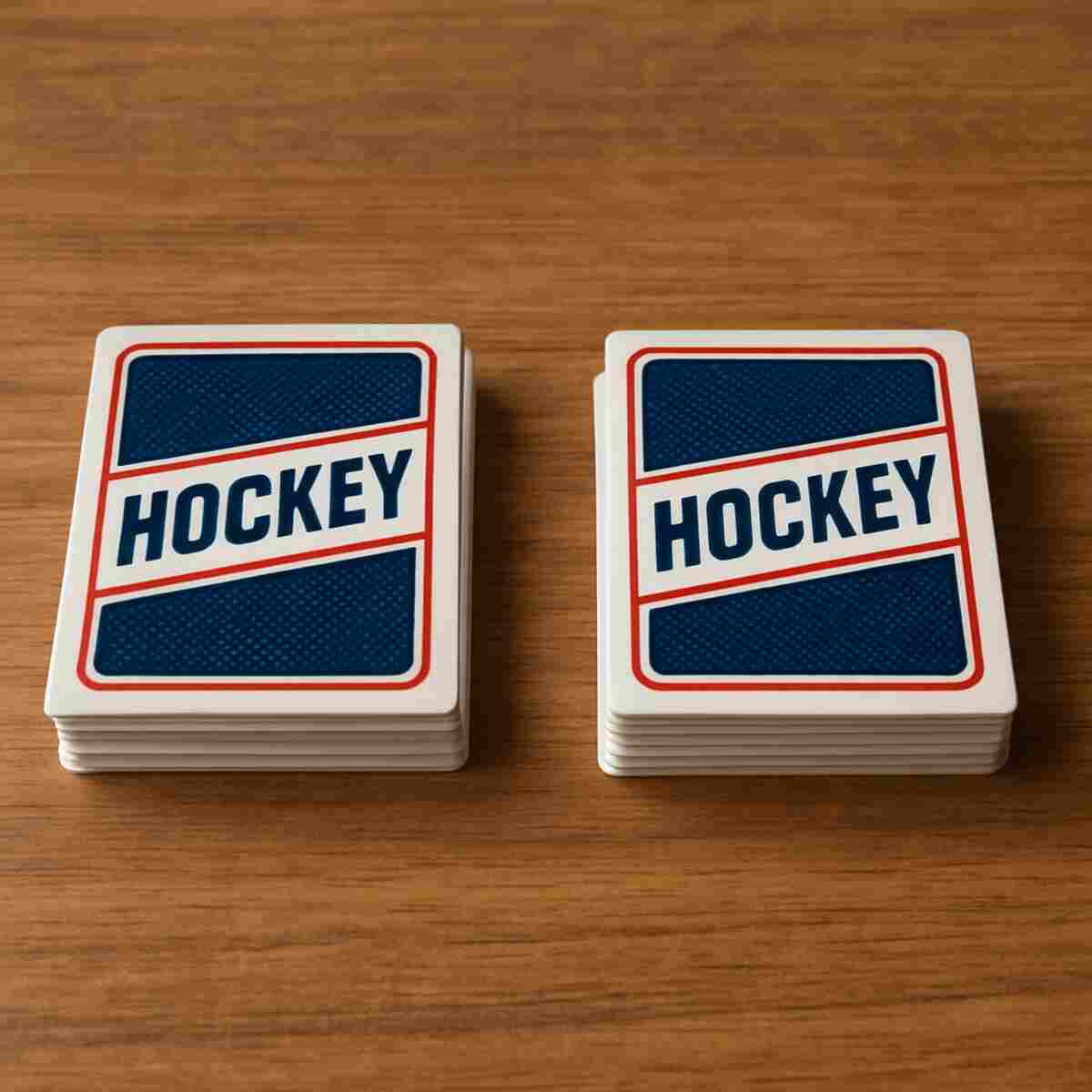
Have an old box of hockey cards gathering dust? Before you dismiss them as simple collectibles, you should know they hold the key to a fast, fun, and surprisingly simple game. The best part is you don’t need any special or valuable cards; any card with player stats on the back will work perfectly, making this a fantastic use for all those common cards and doubles you’ve accumulated. To know more, check out cadetv.com
To get started, you just need to build your “game decks.” This isn’t about complex strategy; it’s about simplicity. Having each player start with a stack of 15 to 30 random cards provides the ideal length for a quick match. This is widely considered the best way to use duplicate hockey cards because you don’t have to worry about bending or scuffing them during play—the focus is entirely on the fun.
Setting up a tabletop hockey match with cards takes less than a minute. Once your stacks are divided, all you really need is:
- Two players
- A stack of cards (15-30 per player)
- A flat surface
That’s it. With your decks prepared, you’re ready to face off.
Have an old box of hockey cards gathering dust? Before you dismiss them as simple collectibles, you should know they hold the key to a fast, fun, and surprisingly simple game. The best part is you don’t need any special or valuable cards; any card with player stats on the back will work perfectly, making this a fantastic use for all those common cards and doubles you’ve accumulated.
To get started, you just need to build your “game decks.” This isn’t about complex strategy; it’s about simplicity. Having each player start with a stack of 15 to 30 random cards provides the ideal length for a quick match. This is widely considered the best way to use duplicate hockey cards because you don’t have to worry about bending or scuffing them during play—the focus is entirely on the fun.
Setting up a tabletop hockey match with cards takes less than a minute. Once your stacks are divided, all you really need is:
- Two players
- A stack of cards (15-30 per player)
- A flat surface
That’s it. With your decks prepared, you’re ready to face off.
How to Read a Hockey Card for Gameplay
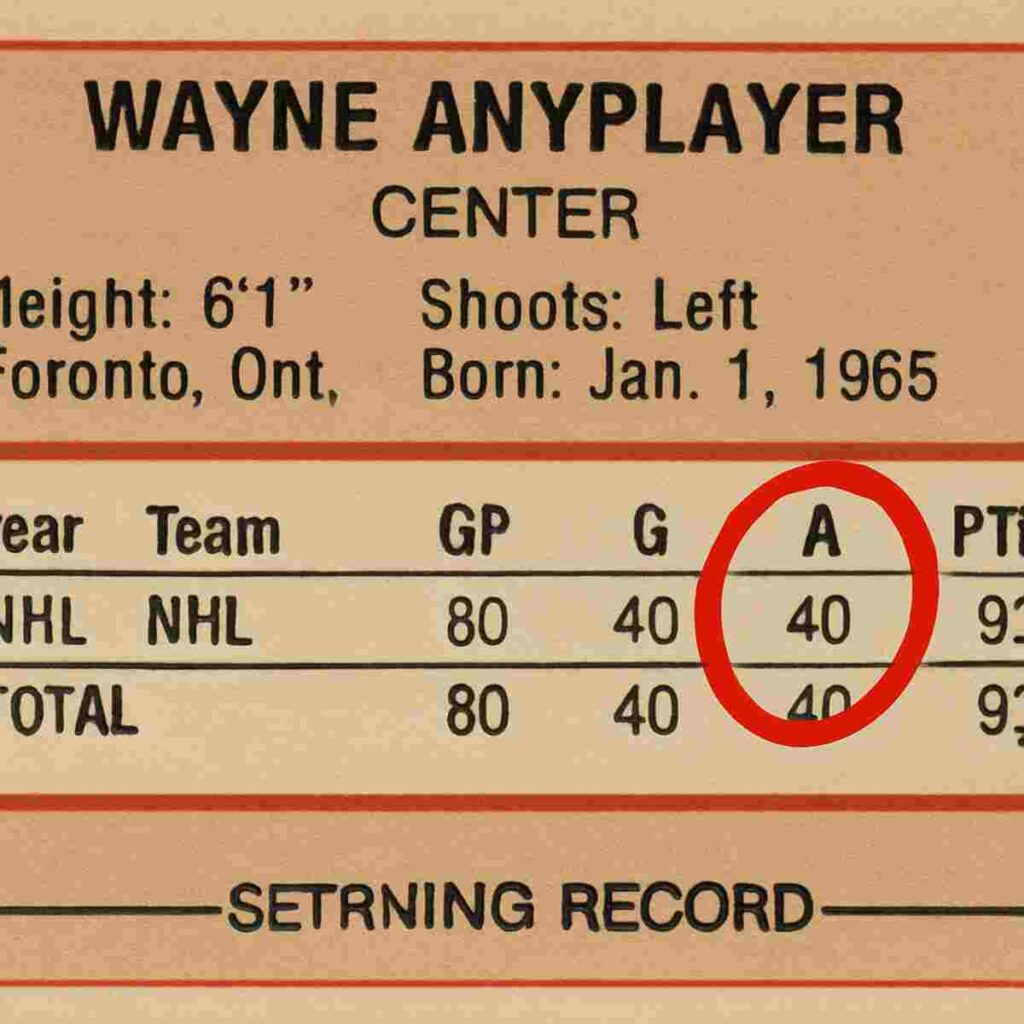
Before you can play, you need to know how to read your “game piece.” Go ahead and flip any hockey card over to its back. You’ll probably see what looks like a small spreadsheet, packed with abbreviations and rows of numbers. For this game, however, you only need to find one single number to get started.
Now, scan the headings on that grid of numbers. You’re looking for the letter G, which stands for Goals. As you can see in the photo, the number in this column tells you how many goals that player scored in a particular season. In hockey, a goal is when a player shoots the puck into the opponent’s net, scoring a point. For our game, it’s incredibly simple: the bigger the number, the better the card.
What about all the other statistics, like “A” (Assists) or “P” (Points)? You can learn what they mean later to add more variety to the game, but for now, you can completely ignore them. The only thing that matters is that “G” for Goals. By focusing on just this one stat, you can start playing immediately. Now that you know how to find the most important number, you’re ready to learn the rules.
The Rules for Your First Round: A Step-by-Step Guide
Ready to put that knowledge to use? The rules for playing with hockey cards follow a quick pattern that you’ll master in seconds. Think of it like a sports version of the classic card game “War.” To begin, both players should have their own pile of cards shuffled and placed face down.
The game is played in a series of fast-paced rounds. Here’s exactly how to play, one turn at a time:
- Deal the Cards: Both players take the top card from their pile and place it on the table, still face down.
- Call the Category: The starting player looks at their card (without showing their opponent!) and chooses a strong category. For your first game, just call out, “Goals!”
- Flip and Compare: Now, both of you flip your cards over. Find the number in the “G” column on each card.
- Declare a Winner: The player with the higher number of goals wins the round!
Winning a round is simple: you collect both cards from the table and add them to the bottom of your own pile. This “call, flip, and compare” sequence is the core of the game. As you collect more cards, your pile grows, and you get one step closer to winning. The ultimate goal is to win all the cards from your opponent.
Of course, using “Goals” every time is just the beginning. As you get more comfortable, the player whose turn it is can choose to call out “Assists” or “Points.” But what happens when you both flip a card and the numbers are exactly the same? That’s when the most exciting part of the game begins.
What Happens in a Tie? The Exciting ‘Face-Off’ Rule
Sooner or later, you’ll both flip cards and discover the numbers are exactly the same—say, both players have 30 Goals. This is where the real fun begins! When a tie occurs, you enter a “Face-Off.” If you’ve ever played the classic card game “War,” this showdown will feel instantly familiar. A tie gives you the chance to win a big pile of cards all at once.
To resolve the tie, both players leave their matching cards face-up on the table. Next, you each place one more card from your pile face-down on top of your original card. This builds the suspense. Finally, you both flip a third card face-up. You then compare the numbers on these new cards, using the same category that started the round (e.g., “Goals”).
The player whose third card has the higher number wins the entire Face-Off. The reward is substantial: the winner scoops up all the cards from the round—the original tied pair, the two face-down cards, and the two deciding face-up cards. Winning a Face-Off can dramatically shift the game in your favor. Now that you know how to handle any round, you’re ready to understand the ultimate goal.
How Do You Win the Whole Game?
Winning individual rounds and exciting Face-Offs is how you build momentum, but what’s the final objective? The goal is beautifully simple: to win every single card from your opponent. With each round you win, your pile of cards grows thicker while your opponent’s shrinks. This back-and-forth continues, with big swings possible after a successful Face-Off, until one player has managed to capture the entire deck.
The game officially ends the moment one player runs out of cards. If your opponent flips their last card and loses the round, they have nothing left to continue with. That final, decisive victory means you’ve successfully collected every card, leaving you with the whole stack.
Unlike games where you add up points, the winner here is unmistakable—it’s the person holding all the cards. The simplicity of the rules makes victory clear and immediate. Now that you know how to play and win using “Goals,” you’re ready to add more variety to your game by using other statistics.
Adding More Fun: Using Assists, Points, and Wins
Playing with “Goals” is a great start, but the real fun begins when you use the other statistics on the back of the cards. Relying on goals alone means that only the top goal-scorers have a great card. By including other categories, you give every type of player—from the selfless playmaker to the rock-solid goalie—a chance to be a winner.
Beyond the letter ‘G’ for Goals, you’ll find two other key stats for skaters. The first is Assists (A), which counts how many times a player helped a teammate score. The second is Points (P), which is simply a player’s Goals and Assists added together. Since Points measures overall scoring contribution, it’s often the best all-around category to use for forwards and defensemen.
To make it even easier, here are the main categories you can call out during a round. The game works exactly the same for each one—higher number wins!
- Goals (G): Best for star goal-scorers.
- Assists (A): Highlights the best playmakers.
- Points (P): The best all-around stat for skaters (G + A).
- Wins (W): The only stat you need for a goalie game.
You might notice that goalies don’t have stats for goals or assists. So what happens when a goalie card is flipped? For them, you use Wins (W). You can even create a fun variation by separating the goalie cards from the skaters and playing a “goalie-only” mini-game where you only use the Wins category. Now that you have several stats for gameplay, the key is knowing which one to pick to give yourself the best shot at winning.
A Simple Strategy: How to Choose Your Category
Now that you know which stats to use, how do you choose the right one to give yourself an edge? One of the simplest and most effective strategies is this: if it’s your turn, you get to peek at your top card before you say anything. This little advantage is your secret weapon. By looking at your card’s numbers, you can pick the category where that player is strongest, giving you the best possible chance to win the hand.
This simple rule adds a dash of skill to the game. For example, imagine you peek at your card and see a player with 15 Goals but 50 Assists. Calling out “Goals” would be a gamble, but calling “Assists” is a much smarter play. You’re using the information you have to make the best choice. This small decision adds excitement, as you hope your opponent’s card isn’t even stronger.
Of course, the game is still mostly about luck. You can have a card with 50 goals, but your opponent might just happen to have a legendary player with 55. That element of surprise is what keeps the game fast, fun, and fair for players of all ages. This simple strategic choice is one of the best NHL trading card game ideas for two people, but the excitement multiplies when you get more friends or family involved.
How to Play With Three or More People
The fun of this simple card game easily expands for bigger groups, making it one of the best family card games for a quick match. The rules are almost identical. The player whose turn it is still peeks at their card and calls out a category like “Goals” or “Points.” Then, every single player flips their top card. Instead of a one-on-one battle, it’s an all-out competition. The person with the single highest number in the chosen category wins the entire pile of cards from that round.
Naturally, with more cards on the table, ties become more common and more exciting. If two or more players tie for the highest number, only those tied players enter a “Face-Off.” Everyone else sits back and watches the tie-breaker. The tied players will each place one card face-down and flip a third, just like in the two-player version. The winner of that “Face-Off” not only wins the tie-breaker cards but also scoops up all the other cards from the original round.
Playing in a group is a fantastic way to find creative things to do with a hockey card collection, as the game continues until only one player is left. As players run out of cards, they are eliminated. The rounds get faster as the group gets smaller, building to a final showdown between the last two players. The ultimate winner is the person left holding all the cards at the end, proving this is one of the most enjoyable games you can play with sports cards, no matter how many people are at the table.
Answering Your Top Questions (FAQ)
Once you get the hang of the basics, a few common questions usually pop up. The beauty of this game is its incredible flexibility—it’s meant to be adapted. Here are answers to some of the most frequent queries.
Can I play with baseball or football cards? Absolutely! The core fun of using player stats for card gameplay works for any sport. Just pick an exciting offensive category and you’re ready to go. For baseball, try comparing “Home Runs” (HR) or “Runs Batted In” (RBI). For football, you can use “Passing Touchdowns” (TD) for quarterbacks or “Receiving Yards” (Yds) for receivers. The rule is the same: the higher number always wins.
What about using more complicated stats? While you certainly can use any stat on the card, sticking to the simple ones is what keeps the game fast and fun for everyone. Categories like Goals (G), Assists (A), and Points (P) are easy to find and compare instantly. This approach is a key difference in the Strat-O-Matic hockey vs homemade card game debate; our game is all about quick, simple fun, not deep statistical accuracy.
Do we need to shuffle the cards? Not at all! Part of the excitement comes from the randomness of grabbing a stack of cards from a shoebox. You might hit a lucky streak with a handful of star players or have to battle back with a run of lesser-known names. There’s no need to find official rules or specific Topps hockey card game instructions—as long as everyone agrees on the category before you flip, you’re playing it right.
Your First Game is 5 Minutes Away
That old box of hockey cards in the attic is more than just a collection—it’s your next game night. Turning forgotten collectibles into a fast-paced battle of numbers is a creative way to find new fun in your collection.
Getting started is as easy as the classic card game ‘War’. Here’s a quick reminder of the rules:
- Deal the cards.
- Call a category (like “Goals”).
- The highest number wins the round. Win all the cards to be the champion!
This screen-free game can be taught and played in under five minutes, making it perfect for connecting with family and friends. So, what are you waiting for? Grab a friend, a small stack of cards, and play your first round right now.